One Secondhand ASIC on the Desk: Measuring It Before It Heats the Room
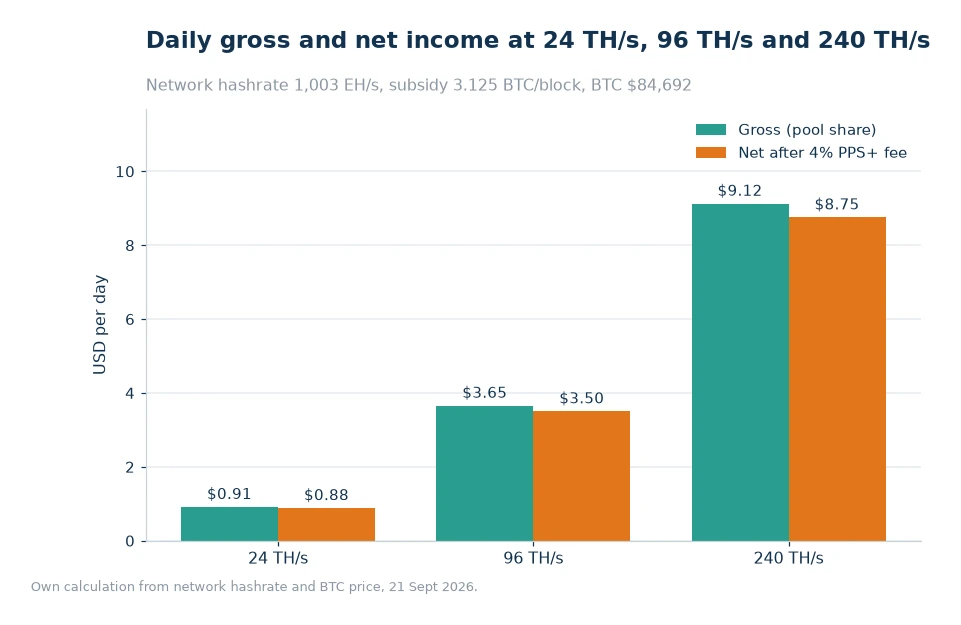
A used miner bought from a friend is a gamble with a fan inside. A 24 TH/s veteran produces only about $0.91 a day gross at today's difficulty, keeping $0.88 after the listed charge. Run the five checks below before paying, because a cheap box with dead boards is not cheap at any price.
Key takeaways
- 24 TH/s earns near 1.077e-05 BTC daily, about $0.91 gross at $84,692 per BTC.
- The listed 4% on the block-reward component leaves roughly $0.88 a day.
- Older small units often burn more power value than the coins they produce.
- Always hash for an hour on the seller's bench and photograph the dashboard.
The classified ad that started it all
It begins with a message and a photo: a dusty unit, a hopeful price, pickup this weekend. The seller quotes the model number the way car sellers quote mileage, fondly and approximately. For 24 TH/s of older silicon, the honest daily figure at network throughput near 1,003 EH/s is 1.077e-05 BTC, and no enthusiasm changes it. Difficulty at 132.76 T applies equally to museum pieces and new arrivals.
Small-scale math is unforgiving in a way large-scale math is not. A warehouse absorbs a weak machine into its average; a desk absorbs nothing, because the single box is the entire operation. At $0.91 gross a day, even a modest power draw consumes the margin, and at residential tariffs the machine can cost more to run than it earns. The purchase question is therefore not whether the box hashes, but whether it hashes efficiently enough for your socket.
That is where estimation tools earn their place. Plug the model's effective hashrate, the current difficulty and the listed PPS charge into a forecaster and read the daily line with cold eyes. The ViaBTC Mining Calculator accepts exactly those inputs, including merged-mining output where relevant, and returns the figure the seller's story must survive.
Five bench checks before cash changes hands
First, photograph the nameplate and confirm the model matches the ad. Second, power the unit and listen: every fan should spin without grinding, and missing blades mean heat trouble within hours. Third, connect it to a pool account, ideally the seller's or a temporary worker of yours, and watch reported hashrate for a full hour against the 24 TH/s rating. Fourth, screenshot the dashboard showing accepted shares and hardware errors side by side. Fifth, feel the exhaust for even heat across boards; a cold section signals dead chips.
Translate what you see into coins on the spot. If the dashboard shows 22 TH/s instead of 24, scale the $0.91 gross proportionally to $0.83 and the $0.88 kept figure to $0.81. Error rates above a few percent deserve the same haircut. Sellers sometimes protest that figures improve after cleaning, and sometimes they do, but pay for the machine in front of you, not the one in the hypothetical.
Settle the price against payback, not sentiment. A $100 box keeping $0.88 a day before power needs 114 days to return its price even with free electricity, and with paid power it may never return it. Newer efficiency classes change this completely, which is why the model efficiency table deserves a look before any secondhand deal. Sentiment mines nothing.
When a small box still makes sense
Three situations rescue the tiny rig. Free or surplus power, such as behind a solar array that otherwise curtails at noon, removes the binding constraint. Education justifies a small loss the way textbooks do; a 24 TH/s unit that teaches worker setup, PPS+ hourly rhythm and wallet withdrawals for the price of a dinner is a fair trade. And cold climates convert waste heat into space heating, letting the exhaust warm a workshop through winter.
Outside those cases, patience beats purchase. Saving the same money toward a modern 200-plus TH/s machine moves the daily line from cents to dollars, as the chart's middle rung shows at $3.65 gross. Pool accounts, wallets and knowledge all transfer to the bigger box later, so nothing learned on the small one is wasted even if the small one itself never pays.
| Size | BTC / day | Kept USD / day | Verdict at home tariffs |
|---|---|---|---|
| 24 TH/s relic | 1.077e-05 | $0.88 | heater or classroom only |
| 96 TH/s stepping stone | 4.307e-05 | $3.50 | marginal, needs cheap power |
| 240 TH/s workhorse | 0.00010767 | $8.75 | viable where power is fair |
Note the middle rung carefully: 96 TH/s keeps $3.50 daily, which survives $0.10 power on efficient firmware but drowns on wasteful settings. The calculator's merged-mining line can add a little where LTC and DOGE joint mining applies, though SHA-256 relics see none of it. Every scenario still settles under PPS+ hourly against current difficulty, so an hour of bench testing predicts the future well.
Cleaning the bargain without killing it
Compressed air is the kindest tool in the workshop. Blow dust from hash boards and power supplies outdoors, working with the fan blades held still so the bearings never overspin. Follow with a soft brush along the heat sinks and a check that every connector seats firmly. A machine that gains a full terahash after cleaning was suffocating, and its seller priced suffocation into the deal without knowing.
Thermal paste is the deeper job and not every bargain deserves it. Repasting boards demands patience, correct torque and hours of careful labor, so reserve the surgery for units whose bench test already proved their chips healthy. A board with dead ASICs gains nothing from fresh paste; it needs component repair or retirement. Spend effort where measurement says effort pays.
Negotiate the pickup terms as carefully as the price. Test the machine on the seller's power, photograph the dashboard showing the full hour of stable hashing and agree in writing on a short return window for hidden board faults. Sellers who welcome bench testing almost always describe their hardware accurately, and the few who refuse have already told you everything their silence contains.
Worked example
Follow the coins for the 24 TH/s box. Each TH/s earns 450 divided by 1,003,000,000 BTC a day, or 0.00000044865. Times 24 gives 1.077e-05 BTC daily, exactly the chart baseline. At $84,692 per BTC, 1.077e-05 times 84,692 equals $0.91 gross. The listed 4% on the block-reward component keeps 96%: $0.91 times 0.96 is $0.88 net. The workhorse rung scales the same: 240 TH/s times 0.00000044865 gives 0.00010767 BTC a day, times 84,692 equals $9.12 gross, times 0.96 equals $8.75 net, matching the chart's top bar.
Frequently asked questions
Is a 24 TH/s miner profitable at home?
Rarely. It keeps about $0.88 a day before power, so at typical residential tariffs electricity alone exceeds income; only free power, heating reuse or education justifies it.
What is the single most revealing test?
One full hour hashing on the seller's bench. Compare reported hashrate to the 24 TH/s rating and count hardware errors; both numbers predict home performance directly.
Does the Profit Calculator handle old models?
Yes. Enter the measured effective hashrate rather than the nameplate, with current difficulty and the listed PPS charge, and the daily estimate reflects the machine as it actually runs.
Offer for the machine you measured
Test for an hour, photograph the dashboard, compute $0.88 kept against your power price and bid only if payback lands inside a year. Otherwise thank the seller, keep the knowledge and keep saving toward the 240 TH/s class where the daily $8.75 line leaves real margin. The best deal in secondhand mining is often the one politely declined.
Sources: ViaBTC calculator, miner-ranking and fee pages for estimation inputs and the listed 4%. Chain inputs read 21 Sept 2026: network near 1,003 EH/s, difficulty 132.76 T, 3.125 BTC subsidy per block, 144 blocks a day, BTC $84,692. Published 11 Nov 2026; figures assume continuous uptime[1].