Quality control in home fragrance is not one inspection at the end; it is a short series of checkpoints, each of which catches a different class of defect. Incoming materials catch substitution. Dosage and blending catch strength drift. Fill weight catches overfill and underfill. Delivery testing catches a product that will not burn or will not wick. Release documentation catches everything that was missed. A run that only checks the finished unit will pass defective product and fail good product.
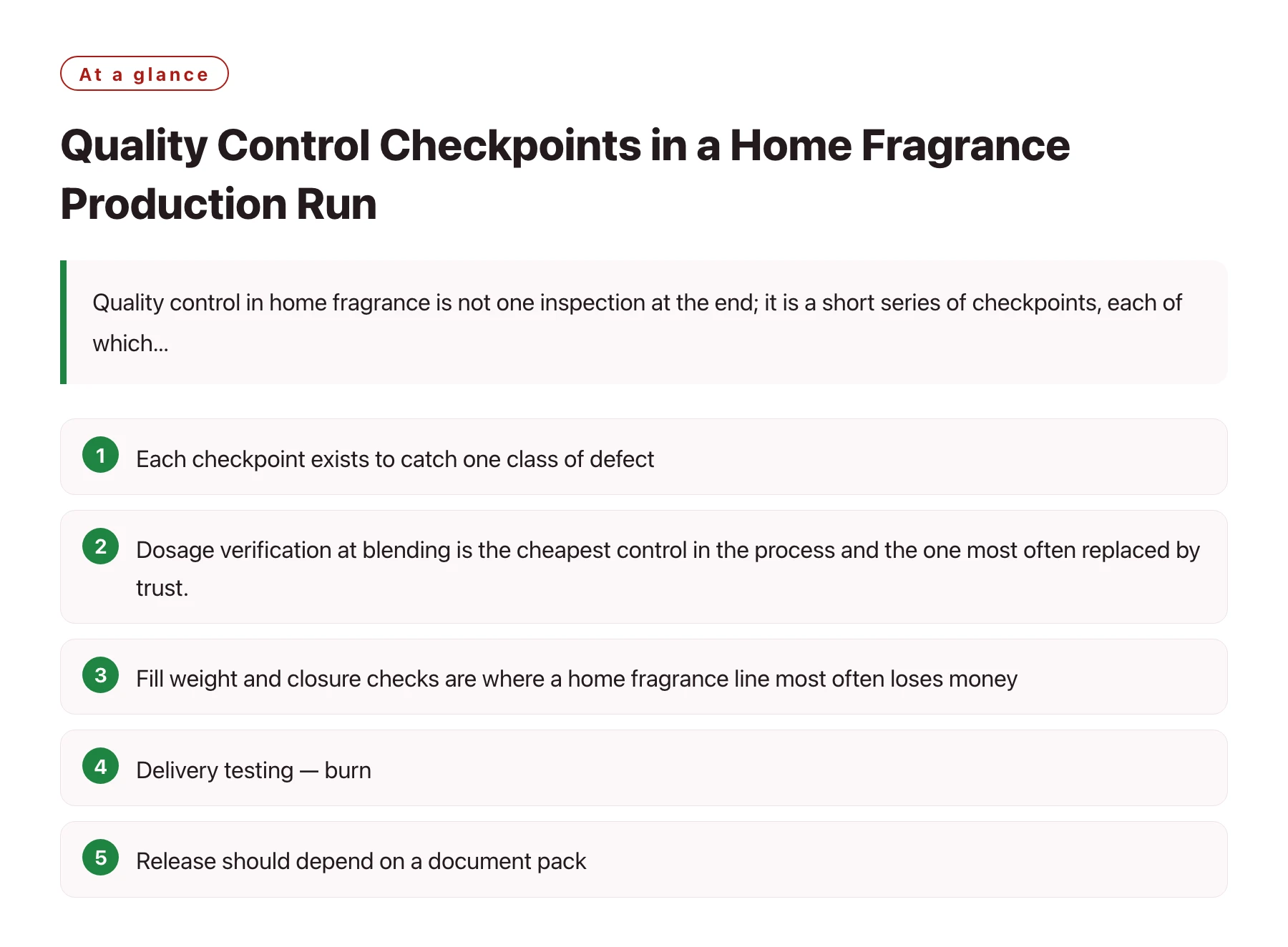
Key takeawaysEach checkpoint exists to catch one class of defect, so removing a checkpoint removes a specific protection rather than adding general efficiency. · Dosage verification at blending is the cheapest control in the process and the one most often replaced by trust. · Fill weight and closure checks are where a home fragrance line most often loses money, because both defects are invisible until the product travels. · Delivery testing — burn, wick draw, spray pattern or evaporation — has to be run on the production substrate at the production dosage. · Release should depend on a document pack, not on a person's judgement that the batch looks fine [1].
Brands that audit a factory for the first time often ask to see the inspection station. It is usually the least interesting part of the process. The checkpoints that determine whether a home fragrance line arrives intact sit earlier: at material intake, at blending, at the filling head and at the test bench.
Here is the sequence a home fragrance run should follow, what each checkpoint protects, and the evidence worth asking for.
The checkpoints, in the order they protect the batch
Incoming material verification
Every oil, substrate, wick, vessel and closure checked against the approved specification and, where relevant, the reference sample retained from previous runs.
Dosage and blending control
The fragrance load weighed or metered against the approved percentage, with the blend record signed. This is where strength drift is caught before it becomes a whole batch.
Substrate preparation check
Wax melt temperature, carrier clarity or wick priming checked against the process parameters, because a substrate produced off-specification changes how the oil behaves.
Fill weight and closure check
Weight measured against the tolerance at defined intervals across the run, with headspace and closure torque or crimp checked on the same sample.
Delivery performance test
Burn test, wick draw, evaporation rate or spray pattern run on finished units from the batch, not on a laboratory preparation.
Appearance and decoration inspection
Artwork position, colour matching against the approved standard and vessel defects checked under consistent lighting.
Pack and release
Final carton inspection, retained samples sealed and stored, and the batch released against a document pack rather than a verbal approval.
Defects and the checkpoint that catches them
| Defect | Where it should be caught | Evidence to request | Cost if missed |
|---|---|---|---|
| Wrong or substituted material | Incoming verification | Material record with supplier lot | Reformulation, re-approval, full batch loss |
| Strength drift from stated dosage | Blending control | Signed blend record with weights | Retail complaints, returns, discounting |
| Underfill or overfill | Fill weight check | Tolerance table with sample readings | Leakage, short weight claims, margin loss |
| Wick or spray underperformance | Delivery testing | Test record on production units | A product that fails in week one |
| Decoration misalignment | Appearance inspection | Approved standard and defect criteria | Rework or retail rejection |
| Missing documentation | Release | Batch file inventory | Customs delay, retail delisting |
The last column is the argument for the whole system. Every checkpoint costs a few minutes on the line; every defect it catches costs a multiple of the batch when it escapes.
Why the delivery test cannot be skipped or borrowed
Home fragrance is a performance product. A diffuser that will not draw or a candle that tunnels is not a cosmetic defect, it is a functional failure, and it usually appears after the customer has already formed an opinion. The only way to catch it before shipment is to test finished production units under conditions close to real use.
This is also where a factory's experience with the format shows. A supplier that also produces scented body products will have safety and stability testing in place, and the scope of cosmetic and household testing that a provider covers is usually published so a buyer can see what was and was not run [1]. That scope statement is more useful on a purchase order than a general assurance, because it names the tests.
The same applies to fragrance-level questions. Where a material is restricted by application category, the compliance work sits at the formula stage, and the industry's safe-use material explains the reasoning behind those limits for the people who have to defend them internally [2]. Quality control then verifies that the approved formula is what was actually blended, which is a different job.
Sampling plans matter more than inspection intensity
Checking more units does not fix a badly designed sampling plan. The question is whether samples are drawn across the run — start, middle and end — and whether they are drawn after the point where the process can drift. A single check at the beginning of a run tells you almost nothing about the last hour of it.
Retained samples are the cheapest insurance available
Sealing a unit from each batch, labelled with the date, batch number and specification reference, costs almost nothing and settles most later disputes quickly. Comparing a complaint against a retained unit answers the two questions that matter: was the batch as specified, and has the product changed since release.
Ask to see one batch file from a comparable product and walk it from material intake to release. A factory with a working quality system will hand it over without preparation; a factory without one will offer a certificate instead. The difference is visible in about ten minutes.
How quality control shows up in cost
Quality control appears in a home fragrance cost model in three places: inspection labour, the tests that are commissioned rather than routine, and the retained stock that never ships. All three are small compared with what they prevent, which is why they survive scrutiny in a mature programme and disappear first in a squeezed one.
The pattern is worth recognising when comparing suppliers. Industry coverage of production and quality practice is one way to see how the subject is treated across the sector [3], and the questions a supplier asks about your specification are usually a better indicator of its control systems than the certificates it lists. A manufacturer that also runs scented body products and holds cosmetics GMP, such as Xuelei, has to maintain a documented process for those lines, and that documentation habit tends to carry across formats; the company's own summary of how it approaches quality sits alongside its background and certifications. For a buyer, the practical step is to ask for the batch file, the tolerance and the test scope, and to compare what arrives across suppliers before deciding which quality system is real. What matters most over a product's life is whether the checkpoint record exists after the launch season, and whether anyone at the factory can produce it when a retailer asks a question six months later.
The guidance behind that kind of release discipline is not specific to luxury positioning. Premium programmes and value programmes run the same checkpoints; the difference is the vocabulary and the level of evidence a retailer demands when something goes wrong, which is one reason a documented process is worth more to a premium line than a promotional one.
The two checkpoints that fail most often
In practice, fill weight and closure checks are the two that get compressed first under schedule pressure, and both produce defects that only appear during transport. A run without those readings is a run with no evidence about the most expensive failure mode. quality control in luxury fragrance production looks at how the same checkpoints are organised where the tolerance for rework is lowest.
What a release decision should require
A defensible release requires the batch record, the fill weight readings, the delivery test result and the retained sample. If a supplier cannot produce those four items for a previous run, assume they will not exist for yours. The wider service scope, including which categories are handled in house, is worth confirming before the order, and More information on the manufacturer's side is a reasonable place to start that comparison.
Sources
- SGS: Cosmetics, Personal Care & Household Testing —— Testing, inspection and certification services for cosmetics and personal care, including microbiological, stability and safety testing aligned with cosmetics GMP.
- IFRA: Safe Use and Fragrance Science —— IFRA's explanation of how fragrance materials are scientifically assessed for safe use and how those conclusions are applied by the industry.
- Cosmetics & Toiletries —— A technical magazine for cosmetic formulators, covering ingredients, formulation science and testing methods.
Frequently asked questions
How often should fill weight be checked during a run?
At defined intervals across the whole run, including the beginning, middle and end, with readings recorded against the tolerance. A single check at startup cannot detect drift later in the batch.
Does a home fragrance product need laboratory testing?
It needs the tests its market and format require: fragrance compliance work at formula stage, hazard information for the liquid, and performance testing for the delivery system. Which of those are routine and which are commissioned should be stated explicitly in the quotation.
What is a retained sample for?
It is the reference that settles later disputes: whether the batch was made to specification and whether the product has changed since release. It should be sealed, labelled with batch and date, and kept by both parties.
Can quality control be added after the first production run?
Checkpoints can be tightened later, but batches produced without records cannot be retroactively documented. Starting with the record in place is cheaper than reconstructing it during a complaint.
How do I compare two suppliers' quality systems?
Ask each for one batch file from a comparable product, a fill tolerance table and a test scope statement. Comparing those three documents is more informative than comparing certification lists.